



Why energy and engineering must align from concept to install
2026-05-22
Energy projects rarely fail because one calculation is missing in isolation. They fail when energy objectives, vessel realities, structural limits, fabrication constraints and approval requirements are treated as separate workstreams. By the time a project reaches mobilisation, every early assumption has become steel, welds, procedures, documentation and offshore risk.
That is why energy and engineering must align from concept to install. For offshore wind, maritime retrofit, heavy lift, decommissioning, dredging, green-tech and traditional energy projects, the best technical outcome is not only a design that passes calculations. It is a design that can be fabricated, approved, transported, lifted, installed, inspected and maintained within the project constraints.
In 2026, this alignment matters even more. Energy projects are larger, schedules are tighter, vessels are in high demand and decarbonisation requirements are driving more retrofits and new offshore infrastructure. The IMO’s 2023 greenhouse gas strategy also keeps pressure on the maritime sector to reduce emissions, which adds new technical scopes around vessel modifications, alternative fuels, energy efficiency systems and onboard carbon reduction technologies.
The core message for technical directors, engineering managers, EPC contractors and marine contractors is clear: concept decisions must be made with installation reality in mind from day one.
The concept phase already defines installation risk
The concept phase may look abstract compared with detailed engineering or offshore execution, but it is where many of the most expensive risks are created. Early choices define the load path, weight growth allowance, fabrication philosophy, vessel selection, lifting arrangement, seafastening strategy, mooring assumptions and approval route.
A concept that ignores vessel capacity can become a detailed design that needs late reinforcement. A layout that ignores access can become a maintenance issue. A structure that is efficient on paper can become slow to fabricate if it relies on complex welds, difficult fit-up or unrealistic tolerances. A temporary works design that does not consider marine motions can create avoidable review comments from the Marine Warranty Surveyor.
In energy projects, the commercial objective is usually clear: produce power, transport product, reduce emissions, remove an asset, increase vessel capability or complete an installation campaign safely and on schedule. Engineering translates that objective into a sequence of physical decisions. Those decisions need to be tested against real execution constraints early, not after procurement has started.
This is especially important in offshore and maritime scopes because the project environment is dynamic. Motions, accelerations, fatigue, corrosion, deck strength, weather windows, crane limitations, stability margins and class rules all influence what is practical. Engineering cannot be separated from marine operations.
What alignment really means in energy and engineering
Alignment does not mean more meetings or a larger distribution list. It means that every technical discipline works from a shared basis of design and understands the operational consequence of its choices.
For an offshore installation structure, the structural engineer must understand the lift sequence, sea fastening loads and fabrication route. For a vessel retrofit, the piping designer must understand class constraints, access limitations, existing hull structure and operational downtime. For a heavy lift, the naval architect must understand ballast planning, stability, crane outreach and load transfer into the deck or quay. For a renewable energy developer, the project team must understand how early design assumptions affect transport, installation and long-term maintainability.
Strong alignment typically includes:
- A clear basis of design with agreed codes, standards, load cases and environmental assumptions.
- Early interface control between structure, vessel, equipment, piping, electrical, operations and fabrication teams.
- Constructability review before design choices become locked into procurement or fabrication.
- Approval planning for MWS, DNV, Lloyd’s Register, ABS or other relevant authorities.
- Weight, centre of gravity and dimensional control throughout the design lifecycle.
- Technical documentation that is traceable, reviewable and suitable for approval.
When these elements are missing, project teams often still reach a technically correct design. The problem is that it may not be the right design for the vessel, yard, lift, schedule or approval route.
From feasibility to install: where alignment matters most
A concept-to-install approach connects each phase of the project instead of treating them as handovers. The goal is to prevent late surprises by asking installation-focused questions before the design becomes expensive to change.
Feasibility and concept selection
At feasibility stage, the project team should identify the limiting constraints, not only the preferred concept. These constraints may include available deck area, allowable deck loading, crane capacity, class notations, tow route, water depth, quay capacity, fabrication access, welding restrictions, transport envelope or mobilisation date.
For example, two seafastening concepts may both satisfy strength requirements. One may require less steel but more complex fabrication and tighter fit-up. Another may use slightly more material but reduce welding hours, simplify inspection and improve installation tolerance. The right choice depends on the total project risk, not on structural efficiency alone.
This is where engineering judgement matters. Optimisation should not only mean minimum weight. It should mean safe, buildable and approval-ready design with controlled cost and schedule exposure.
FEED and basis of design
During FEED, the project needs enough definition to support procurement, vessel planning and approval strategy. Load cases should be credible. Interfaces should be documented. Assumptions should be visible. The project should avoid hidden dependencies that only appear during detailed engineering.
For offshore and maritime scopes, the basis of design should cover more than static strength. It should address motions, accelerations, fatigue where relevant, stability, lifting dynamics, transport conditions, grillage behaviour, connection design, temporary supports and installation tolerances.
This stage is also the right time to engage with MWS or class requirements. Late approval engagement often creates avoidable rework because the design team discovers that documentation, load combinations or checks do not match the reviewer’s expectations.
Detailed engineering and fabrication readiness
Detailed engineering is where concept quality becomes visible. A practical concept produces clear drawings, rational welds, accessible connections, manageable plate thicknesses and predictable fabrication sequences. A weak concept often creates local clashes, excessive reinforcement, awkward weld access and drawing revisions under schedule pressure.
For marine fabrication, steel detailing is not a low-value drafting step. It is the bridge between engineering intent and production reality. Shop drawings, part lists, weld details, tolerances and model coordination determine whether the yard can build efficiently and whether inspection teams can verify the work.
The same applies to piping and retrofit scopes. A vessel modification may look straightforward until legacy drawings conflict with the actual onboard situation. Routing, supports, penetrations, class requirements, access, maintainability and hot work restrictions need to be considered together.
Transport, lift and installation engineering
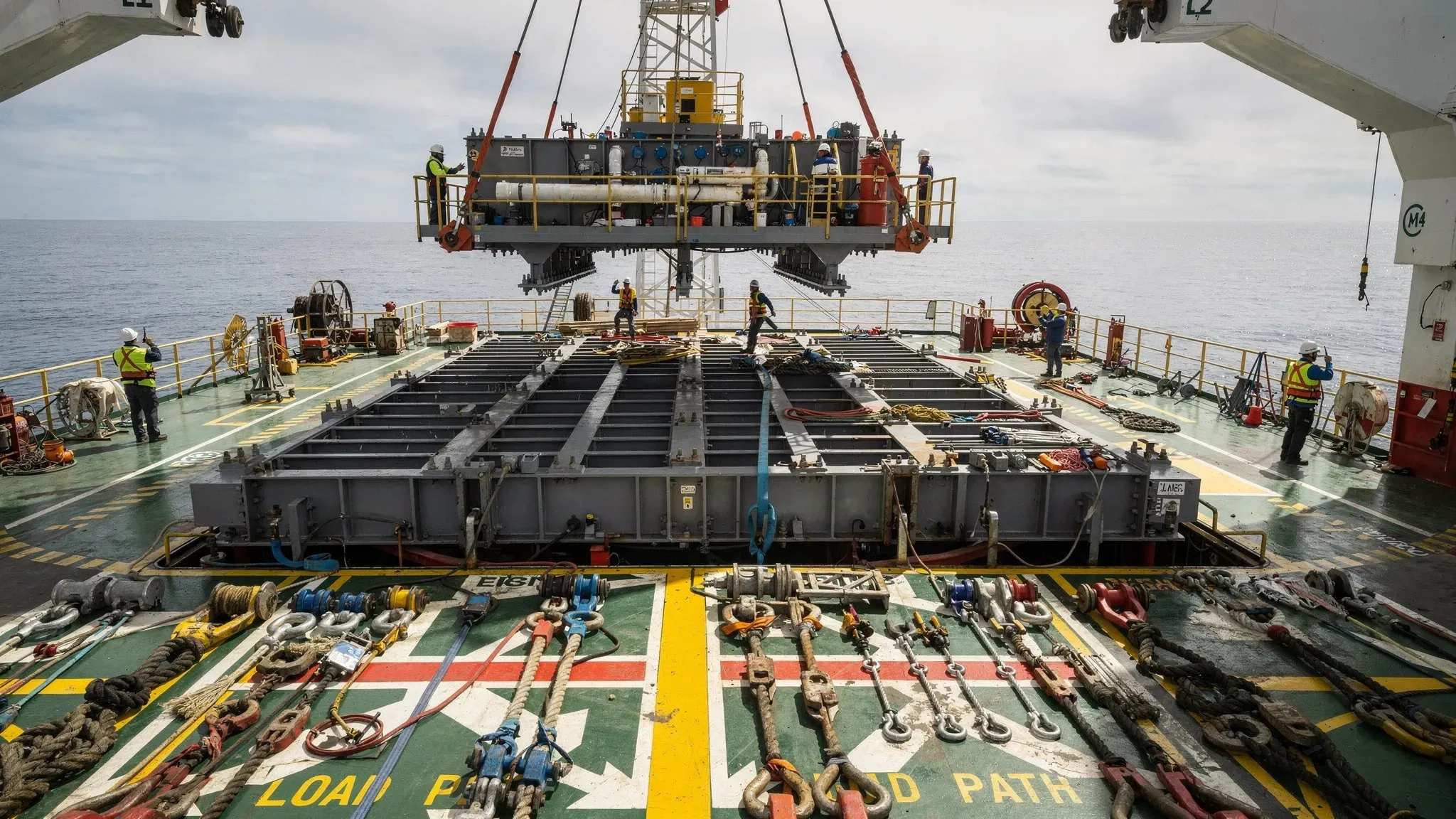
Installation is where assumptions are tested by gravity, weather, vessel motion and time pressure. Lift points, slings, spreader bars, padeyes, grillages, seafastening, mooring arrangements and ballast plans must function as one system.
A lift analysis that does not match the actual rigging arrangement can delay site work. A grillage that ignores underdeck structure can overload the vessel. A transport design that does not control centre of gravity can create stability concerns. A procedure that is difficult to explain to the crew can increase execution risk.
Good energy and engineering alignment ensures that calculations, drawings and procedures tell the same story. The offshore team should not have to interpret conflicting documents during mobilisation.
The cost of separating engineering from project execution
Separating design from execution can look efficient at first. A project may move quickly through concept, procurement or preliminary drawings. But if engineering decisions are not tested against installation and approval realities, the cost usually appears later.
Common consequences include late reinforcement, additional steel, revised sea fastening, fabrication delays, extended class review, missed mobilisation windows, unclear responsibilities and offshore standby costs. In many offshore projects, the cost of one delayed vessel day can exceed the cost of doing the right engineering review earlier.
There is also a quality cost. When teams are forced to solve design issues late, they have fewer options. They may choose heavier solutions, more conservative reinforcement or temporary fixes because there is no time to optimise properly. That can increase fabrication time, vessel loading, inspection effort and future maintenance burden.
The cheapest engineering package is rarely the lowest-risk solution if it creates rework downstream. For technical leaders, the better question is not “How fast can we produce drawings?” but “Will this engineering package support safe approval, fabrication and installation without avoidable revision cycles?”
Key interfaces that need early control
Complex energy projects have many interfaces, but several consistently determine whether engineering stays under control.
Weight and centre of gravity control is critical for lifting, transport, stability and vessel loading. Weight growth should be managed as an engineering risk, not discovered at the end.
Load path definition must be clear from equipment or module into temporary works, vessel deck, underdeck structure and final supports. Ambiguous load paths create review comments and site uncertainty.
Vessel capability needs to be checked early, including deck strength, crane outreach, stability, mooring, ballast, clearances and operational limitations.
Fabrication method should influence design choices. Plate thickness, weld access, tolerances, lifting points and assembly sequence all affect cost and schedule.
Approval documentation should be planned from the beginning. Calculations, FEM models, drawings, reports and procedures need to be consistent, traceable and suitable for MWS or class review.
Operational communication matters because offshore teams execute the design. Animations, clear lift sketches, step-by-step procedures and visualisations can help explain complex marine operations during tenders, QHSE briefings and mobilisation.
Practical examples across energy and maritime projects
Offshore wind transport and installation
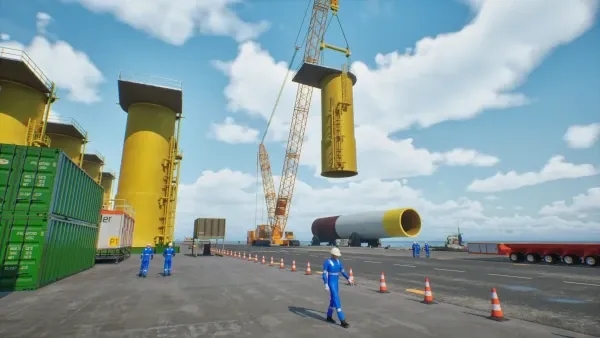
Offshore wind projects depend heavily on temporary works that may not remain in service after installation, but still carry major risk. Foundation transport, monopile handling, transition piece support, boat landings, lifting tools, grillages and seafastening structures all need careful integration with vessel behaviour and installation methods.
A seafastening design should not be treated as an isolated steel frame. It must account for accelerations, load transfer, deck capacity, weld access, fabrication sequence, sea state limitations and removal after installation. If the installation team plans to reuse the equipment, durability, inspection access and handling also become important.
Early alignment can reduce steel use and fabrication complexity while maintaining safety margins. It can also support faster approval because the documentation is structured around the actual marine operation.
Vessel retrofits and green technology integration
Maritime decarbonisation and efficiency improvements are increasing retrofit demand. Onboard carbon capture systems, alternative fuel arrangements, emissions reduction equipment, energy-saving devices and new piping systems all require integration with existing vessels.
Retrofits are rarely clean-sheet designs. Legacy information may be incomplete. Space is limited. Existing structure, piping, ventilation, access routes and class constraints can restrict options. A design that works in a 3D model may still be difficult to install during a short yard stay if access, lifting path or hot work restrictions are not addressed early.
Logistics also matter. Retrofit projects often involve temporary storage, pre-assembled skids, spare parts, lifting accessories and site equipment that must be available before the vessel enters the yard. For land-side staging, inspected shipping containers for temporary storage and logistics can be one practical part of the wider planning process, provided the storage approach is integrated with transport, yard access and installation sequencing.
The engineering priority is to reduce downtime. That requires a design package that supports class review, prefabrication, installation planning and onboard verification before the vessel is taken out of service.
Heavy lift and decommissioning
Heavy lift and decommissioning scopes often involve uncertainty. Existing assets may have incomplete records, degraded structure or uncertain weights. Removal operations may involve unusual load cases, restricted access and limited offshore weather windows.
In these projects, alignment between structural engineering, marine operations and lifting engineering is essential. FEM checks, weight reporting, rigging design, cutting strategy, stability assessment and transport planning all need to support the same removal method.
A practical design approach can minimise reinforcement by proving where strength is already sufficient and identifying exactly where local strengthening is needed. This reduces offshore work, fabrication time and mobilisation risk.
Dredging, heavy civils and marine infrastructure
Energy and maritime infrastructure increasingly overlap with dredging, quay upgrades, bridge installations, port energy hubs and heavy civil marine works. These projects often combine land-based construction constraints with marine lifting and transport constraints.
The same alignment principles apply. Temporary works, skidding systems, lifting beams, mooring arrangements, deck layouts and installation aids must be designed for real execution. Early engineering input can help contractors choose methods that reduce steel, simplify fabrication and fit available equipment.
How technical leaders can improve concept-to-install alignment
Better alignment starts with project governance, but it becomes real through technical discipline. Engineering managers and project directors can improve outcomes by building the right checks into the project rhythm.
One effective approach is to hold early constructability and marine-operation reviews before the design is frozen. These reviews should include structural engineers, naval architects, heavy lift engineers, fabrication leads, operations teams and approval specialists where relevant. The aim is not to slow the project down. The aim is to identify the decisions that would become expensive to change later.
A second priority is to maintain a live assumption register. Offshore and maritime projects often begin with incomplete information, which is normal. The risk comes when assumptions are forgotten and treated as facts. Vessel data, weights, metocean criteria, equipment dimensions, allowable loads, class requirements and fabrication constraints should be tracked until they are verified.
A third priority is to make documentation approval-ready from the start. Calculation reports, FEM outputs, drawings and procedures should be structured so reviewers can follow the logic. If documentation is fragmented, inconsistent or missing key load cases, approval cycles become longer and less predictable.
Technical visualisation can also help. For complex lifts, retrofits, vessel interfaces or offshore installation sequences, animations and clear 3D views can reduce misunderstanding between engineering, operations, QHSE, clients and site teams. Visuals do not replace calculations, but they make the engineering intent easier to communicate.
Finally, leaders should treat external engineering partners as part of the project execution team, not only as extra capacity. The value is highest when external specialists contribute engineering judgement, practical design input, approval awareness and fabrication understanding.
Where Fusie Engineers fits in
Fusie Engineers supports clients across offshore wind, maritime, energy, heavy lift, vessel retrofit, decommissioning and related marine sectors. The team combines structural engineers, mechanical designers, heavy lift engineers and naval architects to support projects from concept and calculations through detailed engineering, drawings and operational readiness.
Typical scopes can include offshore structural design, seafastening, grillages, custom installation tools, ship design, vessel retrofits, piping design, marine engineering, steel detailing, FEM calculations, motion analyses, lifting arrangements, mooring reports, stability checks and approval documentation, depending on the project need.
The practical value is in connecting engineering decisions to execution. Designs are developed with fabrication, installation, maintenance and approval in mind. That helps clients reduce rework, avoid unnecessary steel, control documentation quality and make complex operations easier to review and execute.
Fusie Engineers also supports technical animation and VFX for tenders, QHSE briefings and stakeholder communication. In offshore and maritime projects, this can be valuable when the method is difficult to explain through drawings alone.
For clients with internal teams, Fusie Engineers can provide specialist support where capacity or expertise is constrained. For EPC contractors, marine contractors, shipyards, vessel owners and renewable energy developers, the objective is the same: safe, practical and approval-ready engineering that supports the project schedule.
Frequently asked questions
Why is early engineering alignment important in energy projects? Early alignment prevents concept decisions from becoming late-stage installation problems. It helps teams control weight, load paths, vessel limits, fabrication complexity, approval requirements and offshore execution risk before changes become expensive.
What does concept-to-install engineering include? It includes concept review, basis of design, structural and marine calculations, vessel and installation constraints, fabrication readiness, lifting and transport engineering, approval documentation, detailed drawings and operational support.
How does alignment reduce approval risk? MWS and class reviews are easier when calculations, drawings, procedures and assumptions are consistent and traceable. Early approval planning helps ensure the design is checked against the right standards, load cases and documentation expectations.
When should heavy lift or marine engineering specialists be involved? They should be involved during concept or FEED, especially when vessel capacity, lifting arrangements, seafastening, mooring, stability or offshore installation methods influence the design. Waiting until detailed engineering can limit options.
Can an external engineering partner work alongside an internal team? Yes. Many clients use external specialists to add capacity, review critical scopes, support approvals or provide niche expertise in structural design, heavy lift, naval architecture, marine operations, retrofits or steel detailing.
Align your next energy project before installation risk grows
If your next project involves offshore structural design, heavy lift engineering, ship design, vessel retrofit, piping, seafastening, grillages, decommissioning, renewable energy installation or marine operations, early alignment can reduce risk before it reaches the vessel, yard or offshore site.
Fusie Engineers supports technical teams with practical, buildable and approval-focused engineering from concept to install. To discuss how your scope can be engineered for safer execution, contact Fusie Engineers.


