

Offshore substation design checks that prevent rework
2026-07-23
On an offshore substation project, rework is rarely caused by one isolated calculation error. It usually starts when an assumption, interface, vendor load, access route or temporary condition is discovered too late. By that stage, steel has been modelled, drawings have been issued, fabrication slots are booked, and marine operations are already being planned around a design that may no longer be valid.
For project directors, lead engineers and EPC teams, the right offshore substation design checks should do more than confirm code compliance. They should prove that the platform can be fabricated, transported, lifted, installed, approved, operated and maintained without late redesign. That means checking permanent strength and temporary operations as one connected engineering problem.
Why offshore substation rework becomes expensive so quickly
An offshore substation brings together structural steel, high-voltage equipment, cable systems, HVAC, fire safety, control systems, lifting arrangements, access systems and marine interfaces in one congested asset. A late change in one discipline can easily spread across the full design.
For example, a revised transformer support reaction may require deck strengthening. That strengthening may affect local fatigue details, welding access, coating strategy, cable tray routing and weight control. If the weight or centre of gravity changes, the heavy lift study, sling arrangement, sea fastening design and marine warranty documentation may also need revision.
The cost is not only extra engineering hours. Rework can delay procurement, interrupt fabrication, extend yard time, create approval comments, affect vessel mobilisation, and reduce confidence during offshore execution. For offshore wind developers, transmission owners, marine contractors and shipyards, these delays can quickly become more expensive than the original design effort.
The main rework drivers are usually predictable:
- Incomplete or unstable design basis information
- Late vendor data for major electrical equipment
- Poor coordination between structural, electrical, marine and fabrication teams
- Weight growth that is not reflected in lifting and transport calculations
- Interfaces with jacket, foundation, boat landing, J-tubes or cable decks that are not frozen early enough
- Approval documentation that does not clearly trace assumptions, loads, checks and revisions
The purpose of disciplined design checks is to catch these issues while they are still engineering decisions, not fabrication or offshore problems.
Start with a controlled design basis
Every offshore substation design check depends on the quality of the design basis. If the basis is unclear, every model, calculation and drawing inherits uncertainty. A design basis should not be treated as a formality at the start of the project. It should be a controlled technical document that defines what the design must withstand, how it will be built, and how it will be verified.
For offshore substations, DNV-ST-0145 is a recognised standard that sets expectations for structural safety, offshore conditions and platform-specific requirements. The selected code hierarchy may also include project specifications, class requirements, marine warranty requirements, national regulations, electrical standards and owner-specific criteria.
A robust design basis should confirm environmental data, operating conditions, accidental cases, design life, corrosion strategy, fatigue requirements, equipment loads, access philosophy, temporary transport and installation phases, and approval responsibilities. It should also define who owns each interface, because unclear ownership is one of the fastest ways to create late-stage rework.
The key design basis check is simple but demanding: can every major calculation, drawing and decision be traced back to an approved requirement? If the answer is no, the project is carrying hidden rework risk.
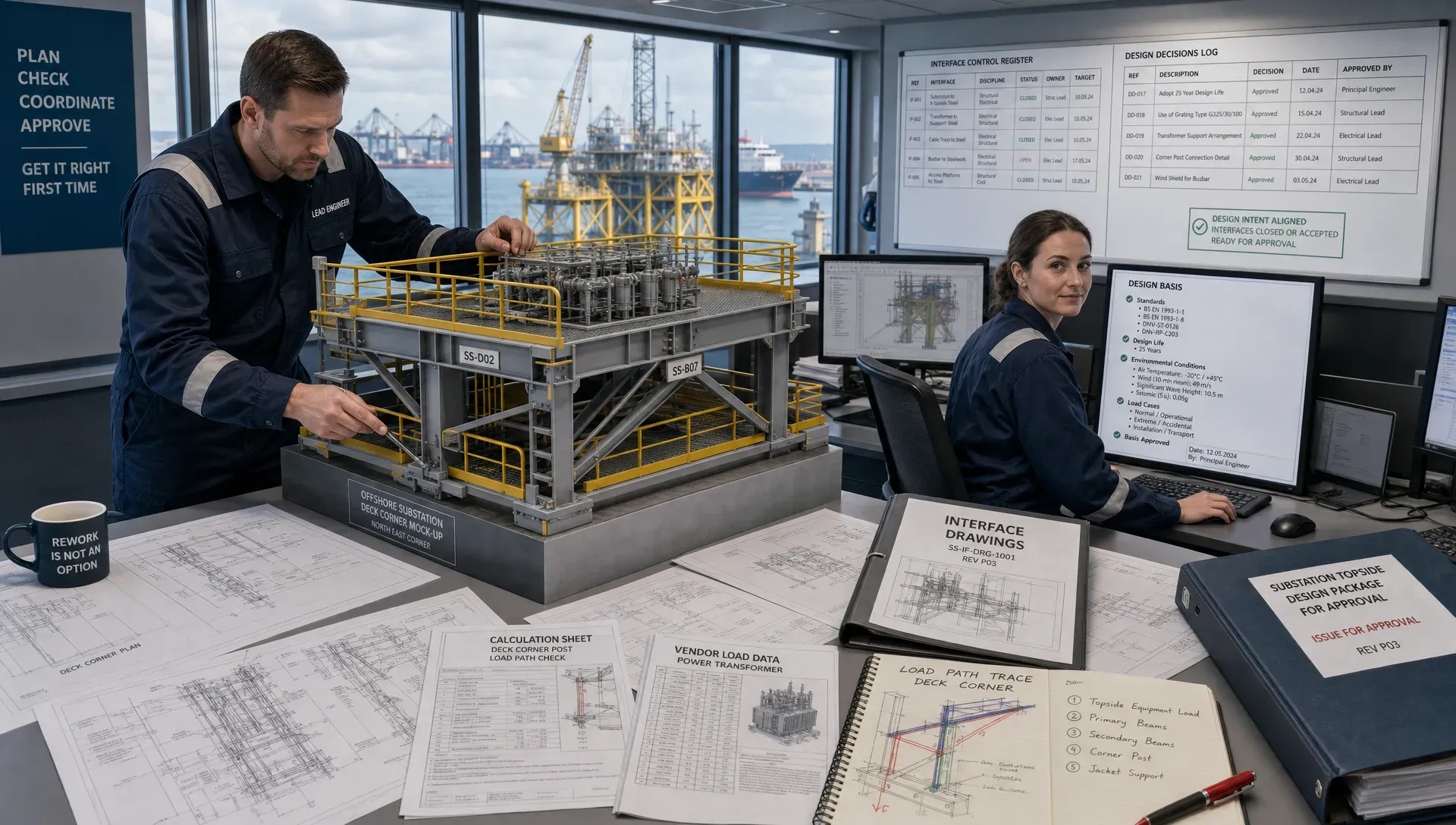
Check interfaces before freezing steel
Offshore substation structures are highly interface-driven. The steel model may look complete, but if penetrations, vendor supports, cable routes, access systems and temporary works are not aligned, the design is not truly ready for detailed engineering.
Interface checks should be performed before structural steel is frozen, not after fabrication drawings are issued. The objective is to confirm that every system has the space, capacity, support and access it needs without forcing late cut-outs, reinforcement or rerouting.
Interface area | Design check | Rework it helps prevent
---
Transformers, reactors and GIS equipment | Verify vendor weights, support reactions, dynamic criteria, clearances and maintenance envelopes | Late deck strengthening, pedestal redesign and access conflicts
Export and array cables | Check J-tube positions, pull-in radii, hang-off loads, bend stiffeners, MCTs and cable tray routing | New penetrations, cable clashes and offshore pull-in issues
Jacket or foundation connection | Confirm leg spacing, elevations, transition details, access platforms and interface tolerances | Misalignment between topside, substructure and installation method
HVAC, fire and safety systems | Check zoning, ventilation routes, fire barriers, escape paths and equipment access | Compartment redesign and safety review comments
Cranes, laydown and handling routes | Verify deck loads, outreach, dropped object zones and maintenance lifting paths | Local reinforcement and operational restrictions
Temporary transport and lifting supports | Align grillages, sea fastening, lifting points and temporary load paths with permanent steel | Rework to underside structure and lifting documentation
These checks are especially important because offshore substations often develop through parallel workstreams. Electrical layouts, structural models, marine studies and fabrication planning may all progress at speed. Without controlled interface reviews, each team can appear to be on schedule while the combined design is drifting toward conflict.
Verify structural load paths, not only utilisation ratios
A structural model can show acceptable utilisation while still creating fabrication, fatigue or approval problems. Offshore substation checks should look beyond pass or fail ratios and confirm that load paths are direct, inspectable and buildable.
For topsides, this means verifying global strength, deck deflections, equipment support stiffness, local plate and beam behaviour, lifting load cases, fatigue-sensitive details, dropped object cases, blast or accidental actions where applicable, and temporary loads from transport and installation. For jackets or supporting structures, checks should also consider pile or foundation interfaces, wave loading, boat landing reactions, J-tube supports and fatigue hot spots.
Connection design deserves particular attention. Large offshore substation structures often contain congested nodes, heavy plate transitions and multiple discipline penetrations. If a connection is mathematically adequate but difficult to weld, inspect or coat, the project may still face rework at the yard. This is why buildability should be reviewed as part of structural assurance, not as a separate concern after design completion.
Practical offshore structural design should reduce unnecessary complexity where possible. Clear load paths, accessible welds, rational plate thicknesses and fabrication-aware details help reduce risk without weakening the structure. This same principle is central to structural engineering choices that improve buildability offshore, especially when schedules are tight and yard feedback must be incorporated quickly.
Keep weight and centre of gravity under active control
Weight control is one of the most important offshore substation design checks because it affects almost every downstream activity. Weight growth can change deck utilisation, lifting reactions, sea fastening forces, vessel selection, stability assumptions, transport accelerations and offshore installation windows.
A reliable weight report should not be a static spreadsheet updated at milestones only. It should be a controlled engineering tool with clear ownership, revision status, confidence level, contingency logic and traceable input from vendors and disciplines. Major equipment weights should be separated from structural steel, outfitting, temporary works, cables, consumables and installation aids so changes can be understood quickly.
Centre of gravity control is equally important. A small shift in equipment layout or temporary steel can change sling loads, crane hook requirements, barge reactions and installation clearances. For heavy lift planning, the design team needs an agreed CoG envelope, not just a single theoretical point.
Weight checks should also include removable items, temporary bracing, sea fastening, lifting tools, rigging, scaffolding assumptions and yard-installed equipment. These are easy to miss early in design, but they can become critical when the lifting study is finalised.
Align lifting, transport and sea fastening with permanent design
An offshore substation may be structurally sound in operation but still unsuitable for the planned transport or lift. Temporary phases can govern local design, particularly at lifting points, grillage supports, sea fastening brackets, underside members and module interfaces.
Heavy lift and transport checks should therefore run in parallel with permanent structural design. The lift arrangement must be checked for sling angles, dynamic amplification, skew load factors, padeye or trunnion capacity, local load introduction, crane capacity, rigging clearances and contingency cases. Transport checks should cover barge or vessel accelerations, grillage reactions, sea fastening load paths, support settlement, fatigue during voyage where relevant, and integration with the installation method.
DNV-ST-N001 is widely used for marine operations and marine warranty review. Whether the project is reviewed by an MWS, class society or client-appointed technical authority, the approval package must show how the temporary design cases connect to drawings, calculations and procedures.
This is where offshore substation design and heavy lift engineering must be tightly coordinated. If lifting points are added after the main steel is designed, local reinforcement can become heavy, awkward and late. If sea fastening is designed after underside structure is frozen, grillage reactions may not align with strong points. The earlier these checks are integrated, the less likely the project is to face late steel changes or review comments. For wider context, Fusie Engineers has also covered heavy lift engineering checks that prevent offshore delays.
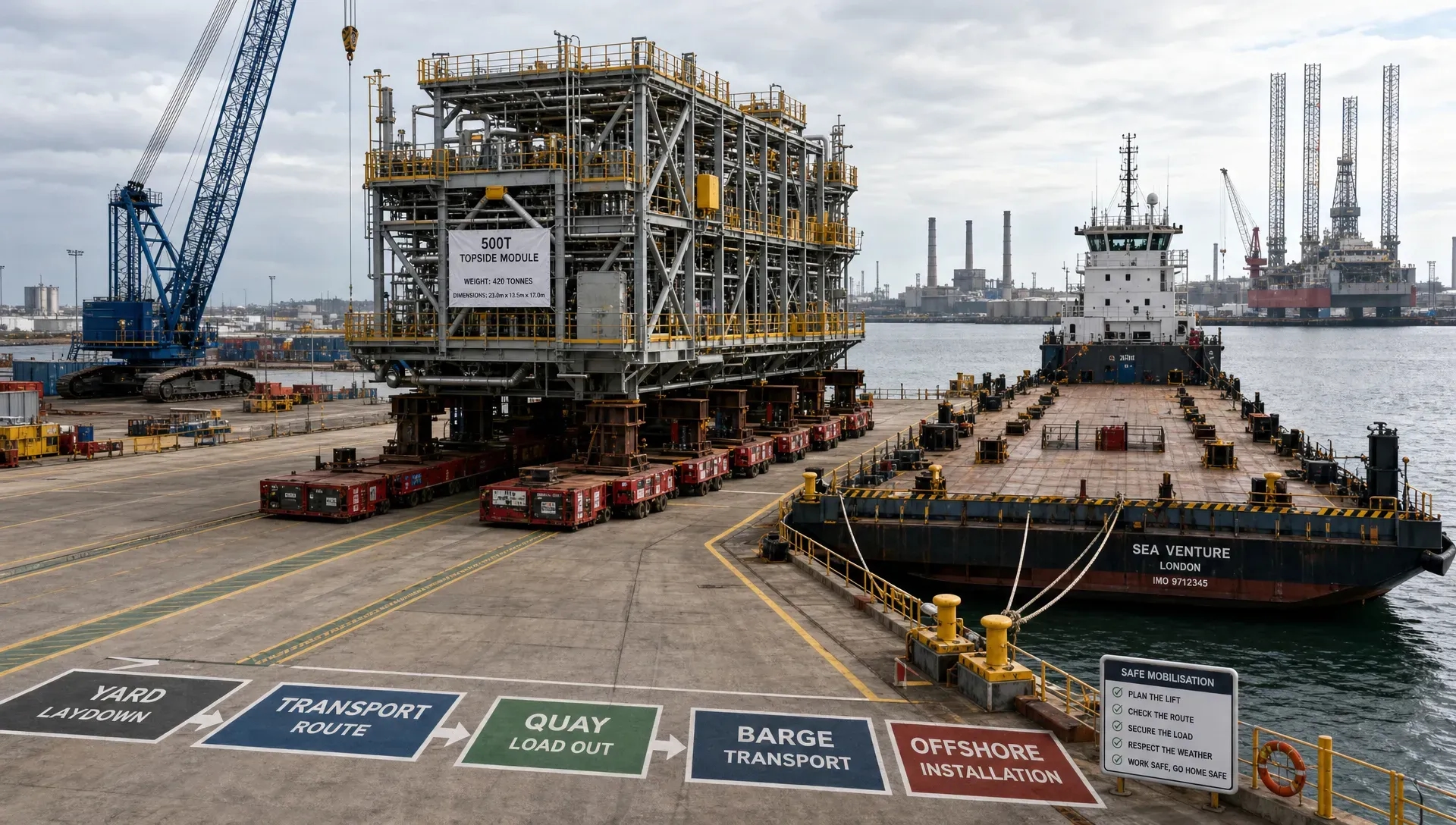
An offshore substation topside module secured on a transport barge at a sheltered dry dock, with grillages, sea fastening brackets, cable deck areas and lift preparation gear arranged around the structure, seen from a slightly elevated angle to show the load paths and interface details.
Make fabrication reviews part of engineering assurance
Fabrication rework often starts when a design is strong on paper but inefficient to build. Offshore substations contain heavy structural members, complex outfitting, equipment supports, penetrations, cable management systems and access platforms. If these details are not reviewed with fabrication in mind, the yard may need to raise technical queries that affect cost and schedule.
A good fabrication review checks whether welds are accessible, NDT can be performed, coating can be applied properly, tolerances are realistic, lifting and turning operations are feasible, and prefabricated sections can be assembled in the intended sequence. It should also check whether temporary supports or transport frames obstruct permanent works, and whether installation aids can be removed without damaging coating or equipment.
Steel detailing should not be treated as a low-value drafting step. On offshore substation projects, detailing decisions influence procurement, weld volume, fit-up, material nesting, assembly sequence and inspection time. Early detailing input can identify where a small design adjustment reduces fabrication complexity without compromising structural performance.
This is particularly valuable when teams are under pressure to reduce steel weight or fabrication hours. The best savings usually come from engineering judgement, not simply thinner members. Rationalising load paths, simplifying connections and avoiding unnecessary exotic details can lower cost while maintaining approval confidence.
Prepare approval-ready documentation, not just calculations
A correct calculation can still create rework if the reviewer cannot follow it. Class societies, MWS teams and client technical authorities need traceable documentation that links assumptions, inputs, load cases, model revisions, drawing numbers and conclusions.
Approval delays often occur when documents are technically competent but incomplete as a review package. Missing load references, unclear revision control, inconsistent terminology, unresolved interface comments or drawings that do not match calculation assumptions can all trigger rework.
Approval item | What to check | Why it matters
---
Design basis | Code hierarchy, load cases, environmental data, safety factors and approval scope are defined | Prevents disagreement about the rules being applied
Structural calculation package | FEM assumptions, boundary conditions, load combinations and utilisation results are traceable | Helps reviewers verify the model without repeated clarification
Lifting and transport package | Rigging, DAF, CoG, sea fastening, grillage loads and vessel assumptions align | Reduces MWS comments before mobilisation
Drawing package | Member sizes, welds, penetrations, equipment supports and temporary works match calculations | Avoids fabrication changes caused by document mismatch
Interface register | Open items, owners, due dates and revision impacts are visible | Prevents late discovery of cross-discipline conflicts
Comment close-out log | Reviewer comments are answered with evidence and drawing or calculation references | Keeps approval progress controlled and auditable
This is where an engineering partner must deliver more than drawings. Offshore projects need coordinated design logic, practical judgement and documentation that can survive review. The same expectation applies across offshore structural design, vessel retrofit, marine operations and heavy lift scopes, as discussed in what offshore engineering companies must deliver beyond drawings.
Validate operations, access and maintainability
An offshore substation is not complete when it has been installed. It must be accessible, inspectable and maintainable throughout its design life. Late maintainability issues can be difficult to fix because they often involve structural openings, lifting paths, escape routes, deck capacity or equipment clearances.
Operations checks should confirm safe access from the selected vessel type, boat landing geometry, transfer arrangements, emergency escape routes, laydown areas, local lifting devices, lighting, maintenance envelopes and inspection access. If a component must be replaced offshore, the handling route should be checked early, including deck capacity and lifting points.
Cable repair and pull-in scenarios also deserve attention. Offshore substations are part of a wider electrical system, and cable interfaces are often congested. A design that looks efficient during initial installation may create unnecessary risk if future cable access, bend radius, protection or hang-off requirements have not been considered.
Maintainability is not only an operator concern. It affects structural design, procurement, fabrication and approval. A platform that is easier to inspect and maintain is less likely to require late design changes when the operations team reviews the asset.
Use design check gates that match project risk
Offshore substation design checks work best when they are tied to decision gates. Waiting until the 90 percent model review to identify basic interface conflicts is too late. Equally, freezing steel before vendor information is stable can lock in assumptions that are expensive to reverse.
A practical check sequence should match the project’s risk profile, procurement strategy and installation schedule.
Project stage | Main design check question | Typical evidence
---
Concept or FEED | Is the offshore substation layout feasible for structure, marine operations, access and cable routing? | Design basis, layout studies, initial weight estimate and interface matrix
Early detailed design | Are major load paths, equipment positions, CoG envelope and approval requirements controlled? | Structural concept, vendor data register, preliminary FEM and weight report
Pre-fabrication review | Are drawings, calculations, penetrations, supports and fabrication details aligned? | Checked drawing package, calculation reports, interface close-out and yard review comments
Transport and installation readiness | Are lifting, sea fastening, grillages, vessel assumptions and MWS comments closed? | Lift study, transport analysis, sea fastening calculations, procedures and approval records
As-built and handover | Do final documents reflect the installed condition and operational requirements? | As-built drawings, inspection records, maintenance information and final close-out log
These gates help technical directors and engineering managers make informed decisions. They also create a disciplined way to manage change. When a vendor update or installation constraint appears, the team can quickly see which calculations, drawings and approvals are affected.
Where Fusie Engineers adds value
Fusie Engineers supports offshore, maritime and energy projects where structural design, marine operations, heavy lift engineering and approval readiness must work together. For offshore substation scopes, that can include structural checks, FEM calculations, lifting arrangements, sea fastening and grillage design, marine engineering input, steel detailing and technical documentation for review.
The value is not only extra capacity. It is practical engineering judgement across the interfaces that usually cause rework: vessel limitations, temporary load cases, fabrication constraints, class or MWS expectations, equipment supports and installation requirements. By considering buildability, transport, lifting, maintenance and approval from the start, the design can stay safer, clearer and more efficient as it moves toward execution.
For EPC contractors, renewable energy developers, marine contractors and shipyards, this integrated approach helps reduce late changes without losing control over safety, quality or documentation.
Frequently asked questions
What are the most important offshore substation design checks? The most important checks are design basis control, interface verification, structural load path review, weight and centre of gravity control, lifting and transport checks, fabrication reviews and approval documentation checks. These areas are where late rework most often starts.
When should MWS or class requirements be considered? MWS and class requirements should be considered from the design basis stage, not only before mobilisation. Early alignment helps ensure that lifting, transport, sea fastening, structural checks and documentation are prepared in a format reviewers can approve efficiently.
How does weight growth create offshore substation rework? Weight growth can affect deck utilisation, CoG, sling loads, crane capacity, vessel stability, transport accelerations, sea fastening reactions and installation clearances. If the weight report is not actively controlled, multiple engineering packages may need revision.
Can design checks reduce steel without compromising safety? Yes, when reductions come from better load paths, simplified connections, accurate modelling, fabrication-aware detailing and removal of unnecessary complexity. Steel reduction should be based on engineering evidence, not arbitrary member downsizing.
What documentation is needed to reduce approval delays? A strong approval package normally includes a controlled design basis, structural calculations, FEM reports, lifting and transport studies, sea fastening calculations, drawings, interface registers and a comment close-out log. The key is traceability between assumptions, calculations and issued drawings.
Need offshore substation design support that holds up in execution?
If your project needs practical offshore structural design, heavy lift engineering, marine engineering or approval-ready documentation, Fusie Engineers can support the work from concept checks through detailed engineering and installation readiness.
By aligning structure, fabrication, lifting, transport and review requirements early, your team can reduce rework risk before it reaches the yard or offshore campaign.